The Bitunix referral code is TradeGetPaid. By registering with this
Author: Trade Get Paid Team
-
Maker vs Taker Fees Explained – Examples, Key Differences & Tips
Key Takeaways- Maker fees apply to limit orders that add liquidity to an exchange’s order book. Taker fees apply to market orders that remove liquidity.
- Taker fees are almost always higher because exchanges reward liquidity providers with lower rates.
- The maker-taker model applies to both spot and futures markets, though futures fees tend to be significantly lower.
- Fee rebate platforms like TradeGetPaid can reduce your effective fees by up to 70%, turning a cost center into partial cashback.
Every trade on a crypto exchange comes with a fee. On most centralized platforms, that fee depends on whether your order adds liquidity to the order book or takes it away. That single distinction is the basis of the maker-taker fee model, which is the standard pricing structure on Binance, Kraken, Coinbase, and nearly every other major exchange.
What Is a Maker?
A maker is a trader who places an order that doesn’t execute right away. Usually this means a limit order set below the current ask (for buys) or above the current bid (for sells). The order sits on the book, waiting for someone to match it. That adds liquidity, and exchanges reward it with lower fees. On some platforms, makers actually receive a rebate, meaning the exchange pays them a small amount per trade.
What Is a Taker?
A taker places an order that fills immediately. Market orders are the most common example, but a limit order priced at or better than the current market price also counts. Since the order removes an existing offer from the book, it reduces liquidity. That convenience costs more: taker fees are higher on nearly every exchange.
Why Are Taker Fees Higher?
Exchanges need deep order books. Without enough resting orders, spreads widen, slippage increases, and the trading experience suffers. Charging takers more and makers less creates a financial incentive that keeps the book populated. Tighter spreads and better price discovery benefit everyone on the platform.
Maker vs Taker Fees on Popular Exchanges
Fee rates vary widely. Below are the base-tier (non-VIP) rates for spot and futures on several exchanges as of 2026:
Exchange Spot Maker Spot Taker Futures Maker Futures Taker TGP Cashback Bitunix 0.08% 0.10% 0.02% 0.06% 70% BloFin 0.10% 0.10% 0.02% 0.06% 50% XT.com 0.10% 0.10% 0.04% 0.06% 45% BingX 0.10% 0.10% 0.02% 0.05% 40% WEEX 0.00% 0.10% 0.02% 0.08% 40% Rates shown are base-tier as of April 2026. VIP tiers and token discounts may reduce these further.
Spot Fees vs Futures Fees: A Difference Most Guides Miss
Most maker-taker guides only cover spot trading. But perpetual futures account for the majority of crypto volume, and the fees there are structured differently. Futures maker fees on many exchanges sit at just 0.02%, compared to 0.08–0.10% on the spot side.
That gap adds up. A trader doing $100,000 in monthly futures volume at 0.06% taker pays $60 in fees. The same volume on spot at 0.10% costs $100. If you’re already trading futures, you’re paying less per trade than most fee guides would suggest.
How Fees Add Up: A Real Dollar Example
Say you trade futures on BloFin at the standard 0.06% taker rate. Here’s what you’d pay per month at different volume levels, and what you’d keep with TradeGetPaid’s 50% cashback:
Monthly Volume Fees Paid (0.06%) TGP Cashback (50%) Effective Cost $50,000 $30 –$15 $15 $100,000 $60 –$30 $30 $500,000 $300 –$150 $150 At $500K/month, that’s $1,800 saved per year just from routing through a rebate link. With Bitunix’s 70% cashback through TGP, the number climbs to $2,520 per year on the same volume.
How to Reduce Your Maker and Taker Fees
- Use limit orders when possible. If your trade isn’t time-sensitive, placing a limit order away from the market price qualifies you for the lower maker fee.
- Increase your volume tier. Most exchanges reduce fees as your 30-day volume grows. Check your exchange’s VIP schedule to see where you stand.
- Hold exchange tokens. Platforms like BingX and BloFin offer fee discounts when you hold or pay fees in their native token.
- Use a cashback platform. Services like TradeGetPaid return a percentage of every fee you pay, maker or taker, as automatic cashback. This stacks on top of VIP or token discounts.
Start Earning Back Your Trading Fees
Now that you know how maker and taker fees work, make sure you’re not overpaying. TradeGetPaid partners with exchanges like Bitunix, BloFin, BingX, and others to automatically return up to 70% of your trading fees as cashback. Nothing changes about how you trade. No minimums, no hoops. Sign up for free at TradeGetPaid and start getting paid back on every trade.
-
5 Ways to Reduce Your Crypto Trading Fees
Trading fees can eat into your profits significantly, especially if you’re an active trader. Here are five proven strategies to minimize your trading costs.
1. Use a Cashback Platform
The easiest way to reduce fees is to sign up through a cashback platform like TradeGetPaid. You can get up to 70% of your fees returned automatically.
2. Use Limit Orders (Be a Maker)
Most exchanges charge lower fees for “maker” orders (limit orders that add liquidity) compared to “taker” orders (market orders that remove liquidity). The difference can be significant – often 0.02% vs 0.06%.
3. Hold Exchange Tokens
Many exchanges offer fee discounts if you hold their native token. This can provide an additional 10-25% discount on top of other savings.
4. Increase Your VIP Tier
Higher trading volumes often unlock VIP tiers with reduced fees. Check your exchange’s fee structure and plan accordingly.
5. Compare Exchanges
Fee structures vary significantly between exchanges. Don’t assume all exchanges charge the same – compare and choose the most cost-effective option for your trading style.
Combining Strategies
The best approach is to combine multiple strategies. For example, using limit orders on an exchange with cashback can reduce your effective fees by 80% or more compared to market orders without cashback.
-
Bitunix Review 2026
What is Bitunix?
Bitunix is a cryptocurrency derivatives exchange that specializes in perpetual futures contracts with up to 200x leverage. Launched in 2022, the platform has quickly gained traction among traders looking for high leverage options and competitive trading fees.
The exchange supports a wide range of trading pairs including BTC, ETH, SOL, and many altcoins. Bitunix focuses on derivatives trading, allowing you to profit from both rising and falling markets without owning the underlying asset.
With over 500 available coins as well as commodities, Bitunix positions itself as a strong contender for crypto traders world wide.
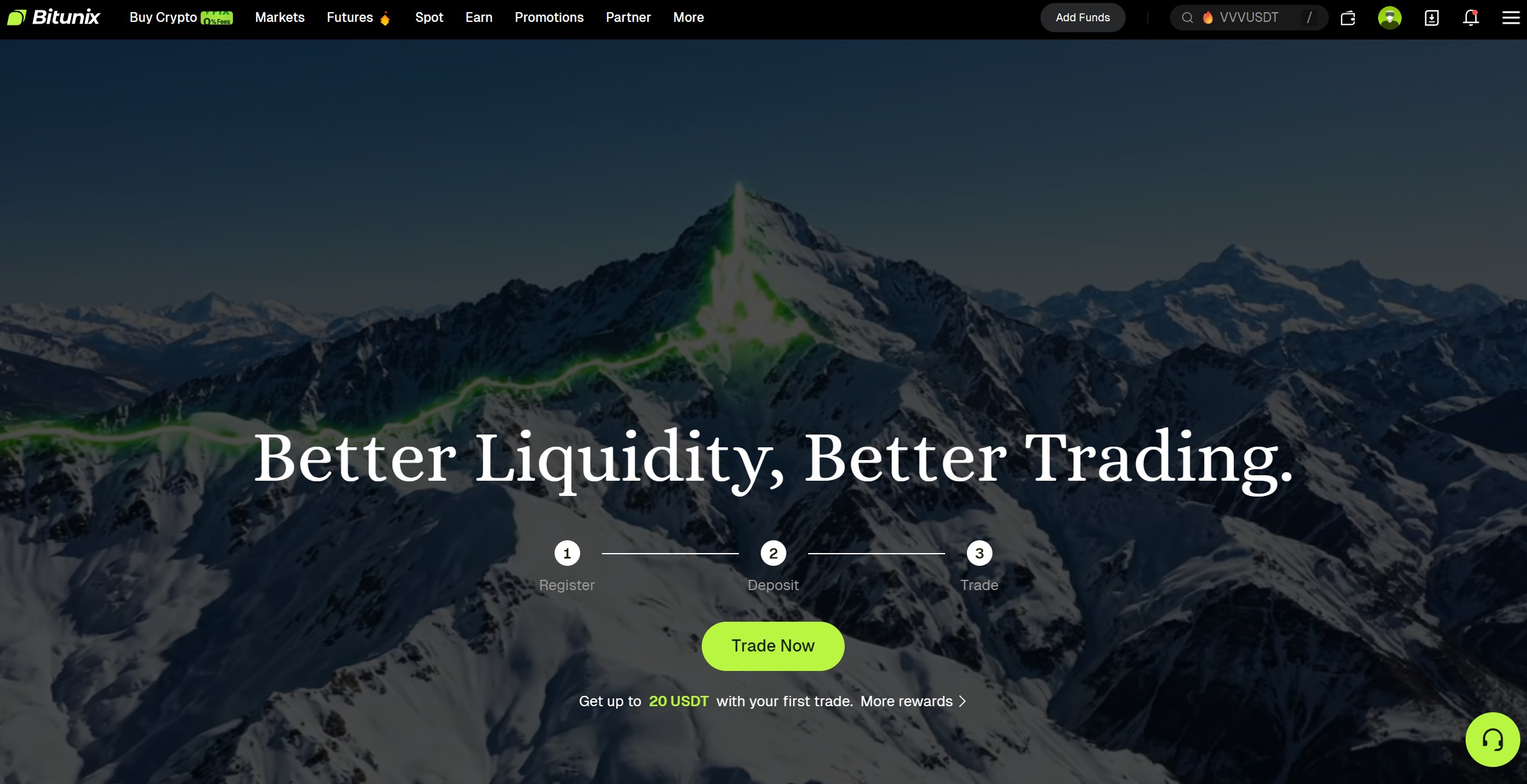
Bitunix home page Trading Experience
The Bitunix trading interface is designed for both beginners and experienced traders. The platform offers a clean, intuitive layout with real-time charts powered by TradingView, comprehensive order books, and detailed position management tools.
Key trading features include:
- Up to 125x leverage on major pairs (BTC, ETH)
- Cross and isolated margin modes
- Multiple order types: Market, Limit, Stop-Loss, Take-Profit, Trailing Stop
- Position calculator and risk management tools
- Real-time PnL tracking
Security & Reliability
Bitunix employs industry-standard security measures to protect user funds and data. The platform uses cold storage for the majority of assets, two-factor authentication (2FA), and advanced encryption protocols. The trading engine is built to handle high-volume trading with minimal latency.
The exchange has maintained a strong security track record since launch, with no major security incidents reported. Regular third-party audits ensure the platform meets security best practices.
Fee Structure
Bitunix offers one of the most competitive fee structures in the derivatives market. The standard trading fees are:
- Maker Fee: 0.02% — paid when you add liquidity to the order book
- Taker Fee: 0.06% — paid when you remove liquidity from the order book
With TradeGetPaid’s 70% cashback, your effective fees drop to just 0.006% (maker) and 0.018% (taker) — making Bitunix one of the cheapest exchanges to trade on.
Why Use TradeGetPaid with Bitunix?
By signing up through TradeGetPaid, you automatically receive 70% of your trading fees back. This is the highest cashback rate we offer on any exchange. Here’s what that means in real numbers:
- Trade $100,000 daily volume → Save $42/day ($1,260/month)
- Trade $500,000 daily volume → Save $210/day ($6,300/month)
- Trade $1,000,000 daily volume → Save $420/day ($12,600/month)
The cashback is automatically credited to your Bitunix account — no manual claiming required. You trade as normal, and the rebates appear in your account balance.
Pros and Cons
Pros
- Highest cashback rate (70%)
- Competitive base fees
- Up to 125x leverage
- Fast execution engine
- Good liquidity on major pairs
- Mobile app available
Cons
- Relatively new exchange (since 2022)
- Limited spot trading options
- Not available in some regions
Verdict
Bitunix is an excellent choice for derivatives traders looking to maximize their profits through fee savings. The combination of competitive base fees, high leverage options, and our industry-leading 70% cashback makes it one of the most cost-effective platforms for active traders.
If you’re trading significant volume, the cashback savings can add up to thousands of dollars per month. Sign up through TradeGetPaid to start earning automatically.
-
How Crypto Cashback Works: A Complete Guide
How crypto trading cashback works at TradeGetPaid
Every time you trade on a crypto exchange—spot or derivatives—you pay trading fees (usually maker/taker). Those fees add up fast if you trade often or use higher volume. TradeGetPaid exists to return a portion of those fees back to you as cashback, without changing how you trade.
The key requirement: you must sign up through our link
Crypto trading cashback only works if the exchange can attribute your account to TradeGetPaid. That attribution happens when you create your exchange account through the TradeGetPaid referral link (the “Sign up / Start earning” link on the exchange page). If you sign up directly on the exchange website without our link, the exchange won’t connect your trading activity to TradeGetPaid, and there’s nothing to rebate.
In other words: TradeGetPaid can’t “guess” it’s you—we need the exchange’s tracking to be in place from the start.
What happens behind the scenes when you trade
Once your exchange account is created through our link, you simply trade as usual. When a trade executes, the exchange charges its standard trading fee (for example, some exchanges list fees as maker/taker percentages).
Because your account is linked to TradeGetPaid, the exchange pays TradeGetPaid a partner/affiliate commission that comes from those fees. TradeGetPaid then shares most of that commission back to you as cashback. This is why you can reduce your net trading costs without needing coupons, promo codes, or manual claims.
TradeGetPaid’s model is straightforward: we keep a small portion of the affiliate commission and return the rest toyou.
How you actually receive the cashback
On TradeGetPaid, cashback is not something you have to request. It’s credited directly to your exchange account, and it’s automated. Depending on the exchange, credits can be processed daily, weekly, or monthly.
You’ll typically see the rebates appear in your exchange balance/rewards area based on that exchange’s payout schedule.
How the “cashback rate” translates into lower effective fees
TradeGetPaid lists a cashback rate per exchange (up to 70%). A cashback rate means: “TradeGetPaid returns X% of the trading fees you paid.”
A concrete example from our Bitunix page:
- Standard fee: 0.02% / 0.06% (maker / taker)
- Cashback rate: 70%
- Effective fee after cashback: 0.006% / 0.018%
So you still pay the normal fee at execution time, but the cashback brings your net cost down afterward.
Does it cost anything to use TradeGetPaid?
No. TradeGetPaid is free to use without any subscriptions or platform fees. The service is funded by the exchange partner commission described above.
Simply register on supported exchanges by using our link, start trading, and enjoy the highest cashback rates in the crypto trading industry.
Quick recap (in plain English)
You sign up on TradeGetPaid, pick an exchange, and create your exchange account through our link.
Then you trade normally. The exchange pays TradeGetPaid a commission for referred activity, and TradeGetPaid returns most of it to you as cashback—credited automatically to your exchange account on that exchange’s schedule.